|
Tædivm
Homepage
UST Private Collection
Brechou
This page was made possible by the combined
effort of diverse members of the
USNS
Unrecognised
States Numismatic Society
|
|
undated
|
|
USNS-BRE-C 001
Year: undated
Metal: Brass
Condition: UNC
Designer:
Mint:
Mintage: unknown
Weight: 4.4 grams
Diameter: 23 mm.
Denomination: 1 Brechou Knacker
Edge type: Plain
|
|
|
ISLE OF BRECHOU: Also spelled Brecqhou, this rocky, 160-acre islet is
politically part of Sark, which in turn is part of Guernsey. Brecqhou is one of the Channel Islands; not only are they a part of the
United Kingdom, they are also very closely associated
with the French/Bretton language and culture.
Previous owners/tenants have included John Thomson Donaldson (1949-66) and
Leonard Joseph Matchan (1966-87). After Matchan’s death there was legal wrangling between his
company (Solaria Investments), which owned the island, and his son. In 1993
it was purchased for £2.33 million by the billionaire businessmen David and
Frederick Barclay. These identical twins (who were knighted in 2000 by Queen
Elizabeth II for their enormous donations to charity) are the co-owners of a
group of hotels and several newspapers, including The Scotsman, The
Business, The Daily Telegraph, and The Spectator; the media
magnates also hold a minority interest in the American firm that controls The
National Enquirer. The brothers guard their privacy to such an extent
that they even erected a grand Gothic-style castle, complete with
100-foot-high granite walls, spires, towers, gilded turrets, battlements, a
moat and a helipad. No expense was spared. According to a builder on the project,
the banqueting room is 80 meters long and has a gold-leaf ceiling; the
library ceiling is hand-painted, inspired by the Sistine Chapel. The
honey-colored, cliff-top fortress (Fort Brecqhou) was finished in 1996 after some
90,000 tons of materials were carried to Brecqhou by boat. At a cost of between 30-60 million Pounds, it is the largest one built
in the 20th century.
The wealthy siblings soon began objecting to the centuries-old legal
restrictions imposed on their private island, which is still considered a
landholding of Sark (a tax-free haven where automobiles and divorce are banned). These
strictures prevent them from selling Brecqhou to a non-citizen of Britain. And because the reclusive duo
has sued for Brecqhou’s independence, their actions have resulted in several
disputes with the government of Sark, which is the last remaining feudal
state in the Western world (the French abandoned Sark in 1553; yet in 1565
Elizabeth I, fearing French encroachment and marauding pirates, granted a
Jersey nobleman named Hélier de Carteret the right
to hold Sark in perpetuity provided he settled 40 armed families on its land
and paid her a twentieth of a knight’s fee annually. The unelected
descendants of those 40 original colonists — known as “tenants” because they
are the owners of the island’s 40 “tenements” [divisions of land] — have
governed life on Sark ever since). Though it has considerable internal
autonomy, the island is a personal fief held by the Seigneur (the hereditary
head of government — or “lord” — who owes fealty directly to the Queen and to
her alone) direct from the British Crown.
From the outset, the Barclays were incensed at having to pay a transfer
tax/levy known as a “treizieme” (a thirteenth of
the land’s value) totalling £179,000 to Michael
Beaumont, Sark’s 22nd Seigneur. Adding to their
collective displeasure, it was the brothers’ goal to divide their estate
equally among their 4 heirs (the twins have three sons and a daughter between
them). But on Sark, unfortunately, the law of primogeniture applied. It dictates that
all property is received by the firstborn male, if there is one; women can
inherit only if they have no brothers. In 1998, when one of the twins’
daughters was denied any inheritance rights under the ancient tradition, the
brothers complained to the Strasbourg, France-based European Court of
Human Rights. The secretive tycoons claimed that Sark was in breach of the European
Convention on Human Rights (to which the British crown dependency had signed
up). In 1999, the dispute over hereditary rights ended in a draw. That’s when
the law regarding the inheritance of realty was finally amended, and Sark’s quaint legislature/parliament, the Chief Pleas,
agreed that proprietorship may be left to a single child of the parents’
choice, man or woman (including daughters and illegitimate and adopted
children), provided that the property was not divided. In turn, the Barclays
recognized Sark’s authority over Brecqhou in 2000.
Nevertheless, the genie was already out of the bottle. It soon became clear
that Sark was breaching the Convention in
numerous other ways, not least in its feudal governance. The Barclays felt
that Brecqhou should not be governed entirely by the Chief Pleas. Therefore,
the Barclays were now determined to change an anachronistic system they
thought oppressive and unacceptable, and they began putting pressure on Sark to change its laws. Sir David
Barclay said in a letter to all members of Chief Pleas: “Our disagreements
began because we want to leave Brecqhou to our children collectively. We
questioned Sark's jurisdiction over Brecqhou
because we believe there are historical grounds for saying that Brecqhou is
not part of the fief of Sark. We believe if Sark intends to govern day-to-day activities in
Brecqhou then we can insist it complies with the European Convention on Human
Rights.” Two of the twins’ objectives were that Sark not to impose any new
tax on Brecqhou and that the treeless slab of rock to get a seat in Chief
Pleas — with perhaps the proviso that it would only vote on matters affecting
it. In 2006, after reviewing the island’s archaic system of government, the
hereditary ruling body of Sark agreed to an overhaul of the island’s constitution. They
voted to introduce a fully democratic government (i.e., universal suffrage)
to the tiny Channel Island, thereby agreeing to finally
“modernize” Sark and to abolish 450 years of
feudal regime. As a result, Mr. Beaumont will be stripped progressively of
his ancient/hereditary powers as feudal lord. The next time Sark goes to the polls it would be
one person, one vote. According to an article (10/14/2006) from The Times, “there
is no jubilation because this was the most reluctant of peasants’ revolts.
The ‘serfs’ were mostly content with their lot.” The Sarkees
“did not hanker for democracy. It was bequeathed to them in the name of human
rights and championed by two billionaire knights — the Barclay twins — who
live in a mock-Gothic castle on the next-door island. ‘Nobody wanted to
change, the island as a whole was perfectly happy with the way things were
going,’ said Mr Beaumont, 79, a genial, old-school
gentleman who fails dismally to live up to the image of a despot. In gentle
self- parody he displays letters in his lavatory addressed to ‘His Highness
Sire of Sark’ and ‘King of Sark Island’.
Scarcely an islander approached by The Times disagreed. ‘It’s been done in
the name of human rights, but none of us ever felt our human rights were
being trampled on,’ said Linda Williams, owner of a bed-and-breakfast.
‘Nobody was baying for change,’ said Adrian Guille,
Mr Beaumont’s head gardener. ‘Everyone appreciated
the system and the way it worked.’ Mr Guille was actually a leader of Sark’s pro-democracy movement, but
backed universal suffrage only from fear that London might impose something worse —
such as rule from Guernsey. Ultimately, for the same reason, even Mr. Beaumont voted for his
own demise…The one real grievance amongst Sark’s
‘serfs’ is that they all have to lease their properties from the 40
‘tenants’.” The Chief Pleas will no longer have 52 seats (40 tenants plus 12
deputies chosen by the islanders); it will now be made up entirely of 28
elected deputies. With all this, the smallest of the four main Channel Islands is certain to lose a chunk of
its reputation as a medieval society.
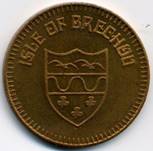
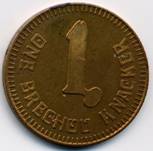
Numismatically, there’s a One Brechou Knacker pertaining to the islet. Its obverse bears a
coat-of-arms; it is the escutcheon (registered at the College of Arms) of Matchan,
who as owner would have been officially known as Sieur
de Brecqhou. The reverse (“knacker”) side has a
long vertical image which not only represents the numeral “1” but which
simultaneously and unmistakably appears to depict an upright portion of the
male anatomy, with a single knacker tenuously
linked to its base. The stylistically graphic, phallic likeness is quite
purposeful, considering just how aptly it complements the racy quality of the
British slang term for “testicle”, employed here as a monetary denomination.
Some folks may be inclined to label the coin too vulgar a trifle to be
coveted by a potential collector.
© 2007 Tædivm
/ C.D. Shiboleth. Information and scans courtesy of E.V.M. McCrea and C.D.
Shiboleth. Layout thanks to G. Cruickshank / USNS.
|

